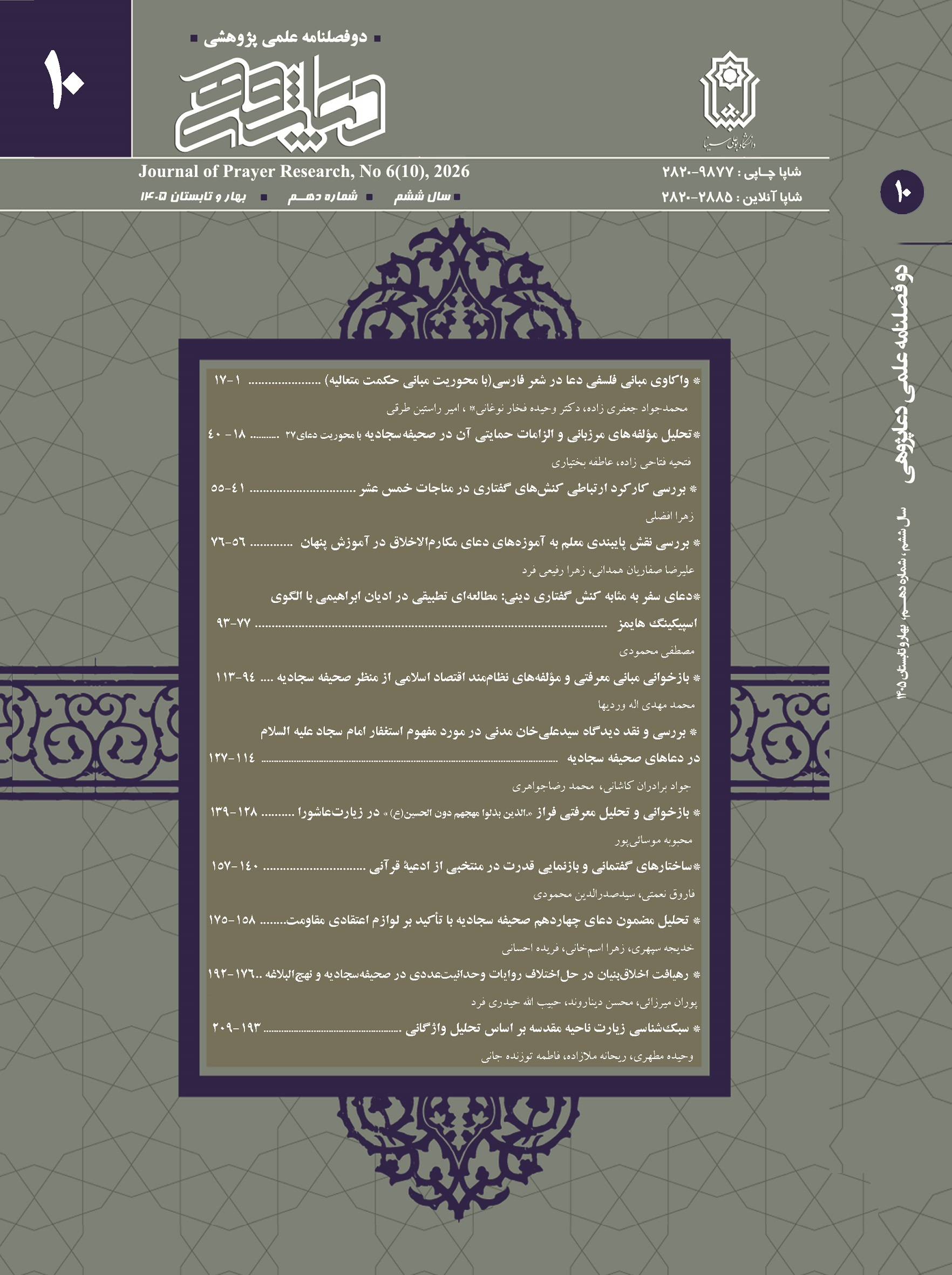
نوع مقاله : علمی- پژوهشی
A Lexical Stylistic Analysis of Ziyarat Nāḥiya al-Muqaddasa
Vahideh Motahari 1,*, Reyhaneh Mollazadeh2 and Fatemeh Tozandehjani3
1*-Assistant Professor, Department of Arabic Language and Literature, Faculty of Literature, Alzahra University, Tehran, Iran.
2-Associate Professor, Department of Arabic Language and Literature, Faculty of Literature, Alzahra University, Tehran, Iran.
3- MA in Arabic Language and Literature, Faculty of Literature, Alzahra University, Tehran, Iran.
Stylistics, as one of the key branches of linguistics, serves as an important analytical tool for gaining a deeper understanding of literary, religious, and cultural texts. By examining various linguistic levels, this discipline enables a more precise recognition of the individual style of the author or speaker, the type of discourse, and the cultural and ideological weight embedded in the vocabulary of the text. One of the important levels of stylistic analysis is the lexical level, which, through the analysis of word structure, frequency, semantic context, cultural and ideological features of words, the type of lexical selection, and related rhetorical devices, can uncover hidden layers of meaning. Ziyarat Nāḥiya al-Muqaddasa is one of the prominent texts in the Shi'a pilgrimage tradition, which honors Imam Ḥusayn (peace be upon him) and his martyred companions on the day of 'Āshūrā. This text is worthy of reflection and analysis from various religious, literary, emotional, and historical perspectives. The literary structure of this pilgrimage text not only carries emotional and epic weight but also reflects religious, historical, and mystical discourses within its inner layers. Focusing on the lexical level of this ziyāra, the present study seeks to examine its stylistic features in the field of lexicology using a descriptive-analytical approach. Emphasizing lexical selection in this ziyāra, the study attempts to show how the specific use of vocabulary and the repetition of certain words contribute to the more effective transmission of religious-mystical concepts and emotions. Among the important findings of this research is that Ziyarat Nāḥiya al-Muqaddasa not only reinforces religious emotions and beliefs through conscious lexical selection but also layers multiple semantic dimensions onto the text by employing epic, ritual, and mystical vocabulary. Therefore, attention to the lexical level is one of the keys to the hermeneutic and interpretive understanding of this sublime text. This analysis demonstrates how words, in combination with the semantic and structural context of the ziyāra, play a significant role in conveying tragedy, pathos, prayer, and epic.
Keywords: Ziyarat Nāḥiya al-Muqaddasa, Stylistics, Lexical Level, Lexical Analysis.